
Kalamazoo Township City Directory Collections
Kalamazoo Public Library, usually called KPL, holds every published Kalamazoo volume from the first issue in 1860, although the series was not issued every year. For Kalamazoo Township research, that irregular publication makes the printed year a hard date. Those city books are a surrounding-place source for Kalamazoo Township, not a guaranteed township-only roster. Kalamazoo Township researchers should keep the city, suburban, and rural runs distinct. County listings are sporadic and stop with the city volume in 1919. For township and rural households, the suburban, rural-route, farm, and criss-cross volumes often answer a more precise question. Start with the collection that matches the address and period, then preserve the volume year and section with every note.
| Collection | Years | Where held | Access |
|---|---|---|---|
| Kalamazoo Township annual-directory lead | 1860 onward, irregular publication | KPL Local History, H 917.7417 K14 | Paper and some microfiche |
| Kalamazoo Township county and suburban leads | County through 1919; suburban 1966-1976 | KPL, including H 917.7417 K141 | Local History Room |
| Kalamazoo Township rural-volume leads | 1919, 1926, 1969, and 1970 | KPL rural call-number shelf | In-person research |
| Kalamazoo Township address-book leads | Criss-cross from 1954; telephone books from 1913 | KPL, H 917.7417 K143 and H 917.7417 M624 | Paper, microfiche, and staff help |
The dates describe what the library holds, not uninterrupted coverage of every street or household. For Kalamazoo Township queries, the suburban books joined the regular run in 1977, while the rural books remain separate checkpoints. A person missing from an alphabetical section may appear in another section, in a different local-unit volume, or not have been captured by that publisher at all.
Kalamazoo Township Directory Shelf
The most direct access point is the KPL Local History Collection on the Central Library's second floor, 315 S. Rose Street, Kalamazoo. Its posted hours are Monday through Thursday 9 a.m. to 8 p.m., Friday 9 a.m. to 6 p.m., Saturday 10 a.m. to 5 p.m., and Sunday 1 p.m. to 5 p.m. Kalamazoo Township patrons can ask Local History staff to separate a city volume from a suburban or rural one, locate the criss-cross run, and point to maps, yearbooks, cemetery leads, newspapers, and clipping files. The collection phone is 269-553-7808.
The KPL city-directory holdings page is a useful first check before a visit. For Kalamazoo Township directory work, it identifies the historical runs, criss-cross material, and address-history notes shown below.
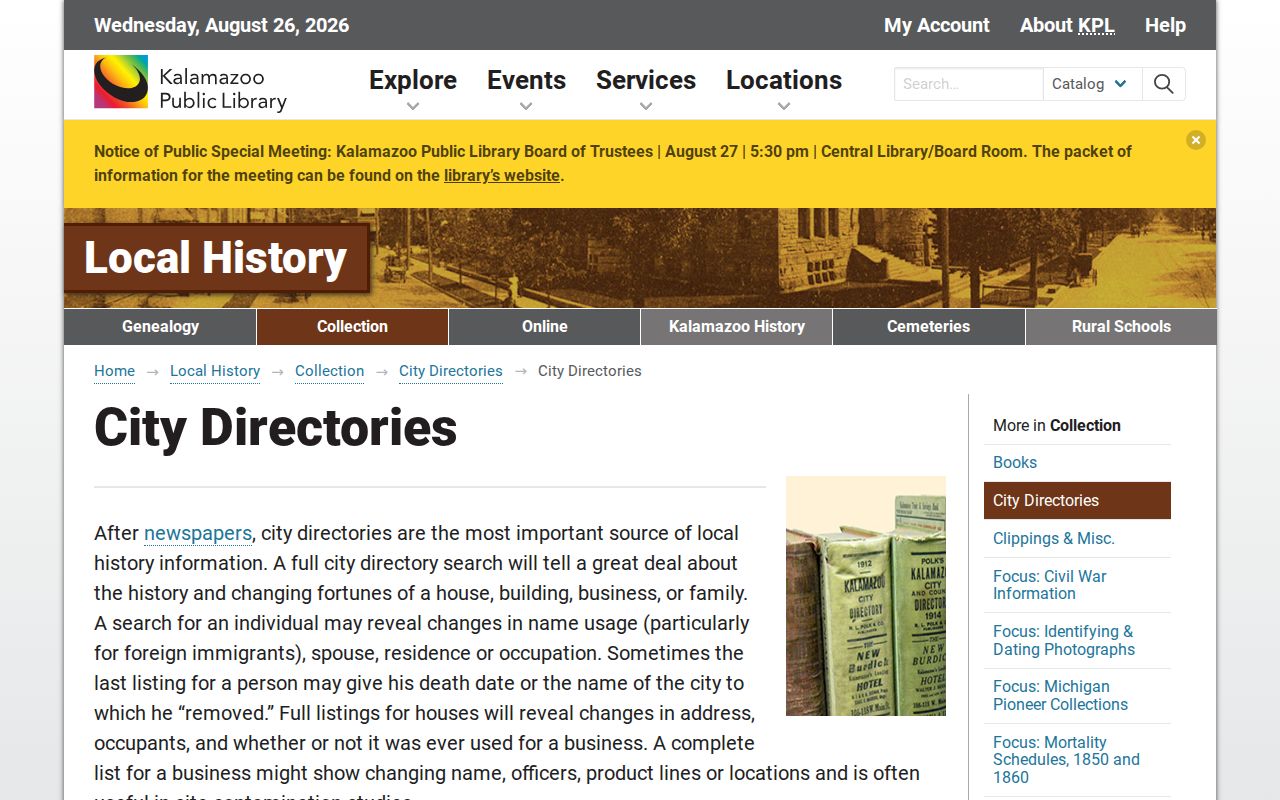
Use the online holdings description to choose a year, then inspect the actual volume and its abbreviation list before treating an entry as evidence. Kalamazoo Township research still depends on the printed and microfiche materials that provide the directory text.
For material that is not a directory, KPL's Local History Online connects Kalamazoo Township researchers with digitized publications, photographs, Pages from the Past, partner collections, and the Local Information Database. That database indexes local newspapers, magazines, historical photographs, and other local-history sources. Its citations can lead back to a staff-held file or microfilm reel rather than an immediate full text.
Reading a Kalamazoo Township City Directory Entry
A Kalamazoo Township directory search has more structure than a simple list of names. KPL describes alphabetical, street-order, and business-by-subject sections, with introductory pages for public buildings, societies, churches, schools, and officials. Read the entry with the year and section in mind. A name and street number can be a strong historical lead, but the book may record a boarder, a business contact, or a household head instead of every person at that address.
| Name | Listed person or household reference, sometimes with a middle initial or a name variation. |
|---|---|
| Spouse or status | Wives began appearing in parentheses after husbands in 1901; widow and boarder clues can help distinguish people with the same name. |
| Role | An occupation, business, or other printed activity may separate two otherwise similar entries. |
| Street reference | House number and street support a comparison with street-order, maps, and later records. |
| Section context | Alphabetical, street-order, and business sections do different work and should be cited separately. |
- Criss-cross directory
- An address-first book arranged by street number and street, used when the address is known but the name is not.
- Householder index
- A name-oriented portion that identifies the person or household reference printed by the publisher, not a complete census of everyone present.
- Abbreviation key
- The volume's explanation of shortened terms. At KPL,
bdsmeans boards at andlabmeans laborer.
Copy the abbreviation key or photograph it with the entry. Kalamazoo Township family research benefits from that detail, especially where someone appears at a family address after reaching adulthood or where a woman's name is recorded under a married surname.
Kalamazoo Township Criss-Cross Directories
The reverse-directory shelf begins with a 1954 Kalamazoo criss-cross volume, with Bresser Company editions in the 1970s. In Kalamazoo Township, these books put the address first and serve as the historical companion to a parcel search when a house number is known. Look up the number and street, record the printed occupant or telephone listing, then compare the alphabetical and telephone sections when available. The run reaches beyond strict city and county lines, so the address still needs a township, city, or postal-area check.
A particular local trap is Miller Road, which KPL says becomes ML Avenue outside the City of Kalamazoo. Similar street names recur in different communities. This is why a Kalamazoo Township directory result should be tied to its full printed address and source year before it is assigned to a particular parcel.
Note: A Kalamazoo Township criss-cross listing is an address-time clue, not proof that every person connected with a household was present there.
Kalamazoo Township City Directory Address Shifts
Kalamazoo Township historical addresses need a local translation before they are matched to a current map. In 1883, Kalamazoo adopted a Philadelphia-style numbering system measured from Burdick, now the Kalamazoo Mall, and Michigan Avenue. When walking away from that point, even numbers were placed on the right and odd numbers on the left. Street-order listings first appear in 1897, so earlier entries need a different set of checks.
The city-wide renumbering in 1925 creates the hardest bridge: there is no 1925 directory, so compare 1924 and 1926 rather than guessing at a new number. KPL notes that the 1932 Sanborn atlas carries old and new house numbers. Names changed too: Cork was St. James, Oakland Drive was Asylum Avenue, Riverview was Seminary, and Vine was Rice. For a Kalamazoo Township address, an old Kalamazoo entry can also be in an area later annexed from the township, so current GIS jurisdiction must remain a separate verification step.
- Record the address exactly as printed, including the directory year and the section used.
- Compare the nearest directory years on both sides of an address change, especially 1924 and 1926.
- Search the former and current street names in the street-order material and on historical maps.
- Match the resulting address to a legal description or parcel only after confirming the present local unit.
Trace Kalamazoo Township Directory Households
A useful Kalamazoo Township household trail moves in small steps. KPL recommends beginning once per decade when no date is known, narrowing to half-decade searches, and then working backward from the present for a building. Directory years provide recurring address and role clues. Federal census schedules offer a dated household snapshot with relationships, ages, birthplaces, and civil-division context. Neither source replaces the other.
- Begin with a known name or address, then select the city, suburban, rural, or criss-cross volume that fits the period.
- Write down the complete entry, including spouse notation,
bds, street name, number, and volume year. - Move backward or forward one available volume at a time and mark every address or name change.
- Pair each decade of directory evidence with the corresponding federal census record, keeping its date separate from the directory date.
- Use Gazette notices, an obituary, probate material, maps, or plats to explain a move, a death, or a changed number.
Disappearance does not tell one story. The person may have moved, died, changed a name, been omitted, or appeared under a different local-unit volume. When a historical name needs modern confirmation, use the address-based records on the Kalamazoo Township by-street directory rather than forcing a current conclusion from an old book.
Kalamazoo Township Gazette and Archive Leads
KPL's Kalamazoo Gazette microfilm is almost complete from 1834 to the present, and its clipping files are strongest from 1928 through 1968. A Kalamazoo Township directory name becomes more useful when paired with a Gazette removal notice, marriage announcement, obituary, real-estate item, or business notice. The Local Information Database identifies names and subjects, while the physical source may be microfilm or a local file. That difference matters when recording a citation or asking staff for help.
The historical trail can reach farther through the Archives of Michigan. The Kalamazoo County guide identifies a Kalamazoo Township cemetery account book from 1851 and naturalization declarations from 1839 through 1968. These are archival collections, not public current rosters. They can nevertheless help resolve a former name, arrival context, burial clue, or family connection when the directory shelf stops short.
The KPL Local History page below presents the broader room that holds Kalamazoo Township directory books alongside maps, yearbooks, newspaper microfilm, and genealogy material.
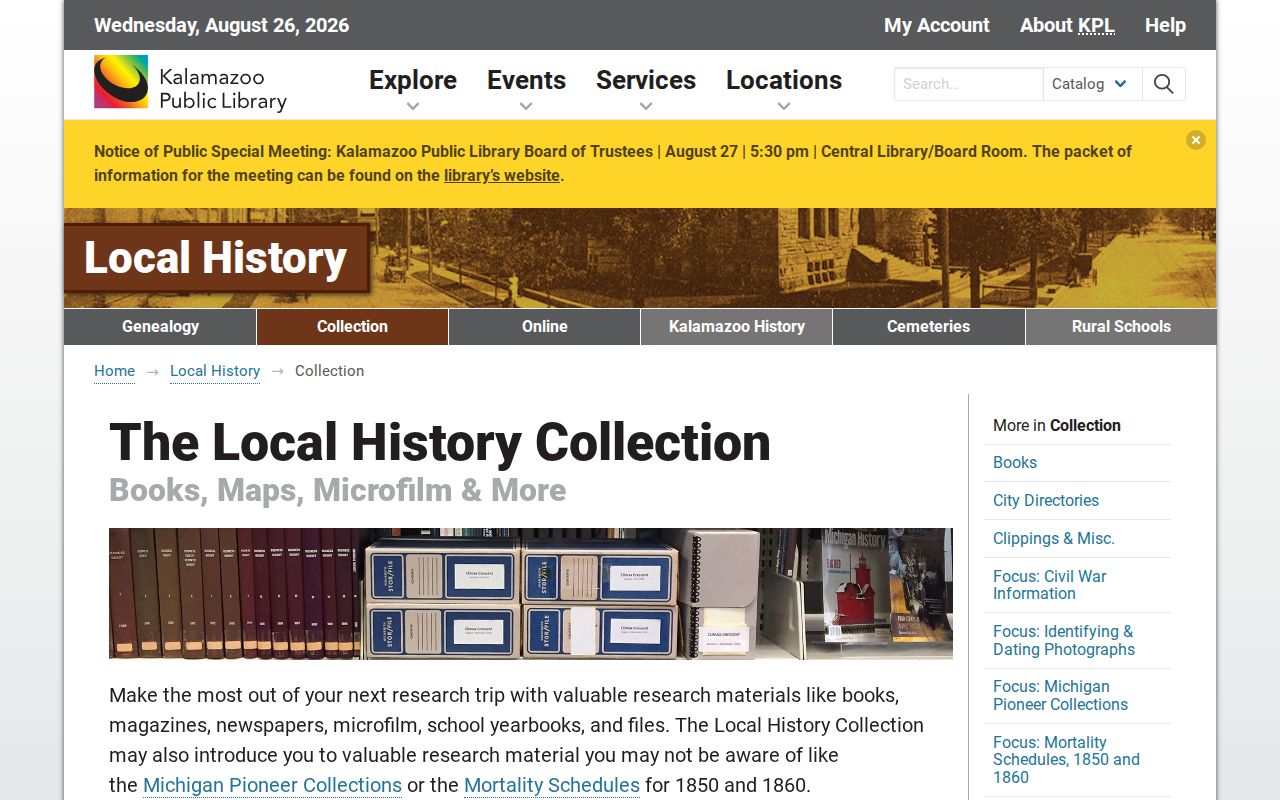
Those companion collections help test a Kalamazoo Township directory trail without turning a single printed entry into a final conclusion. They are especially useful for township addresses that fall near a former city boundary.
What Kalamazoo Township Directory Books Leave Out
Historical Kalamazoo Township directory books are selective snapshots. KPL cautions that suburban directories did not pick up the rural parts of the county, and the older city books are not a township-wide legal record. Telephone subscribers could be unlisted. A person may appear as a boarder, a business contact, or a name under a spouse's entry. A later parcel result also establishes a different moment in time, not the facts of the directory year.
Keep the book title, year, page or section, spelling, and locality with each Kalamazoo Township finding. That small record of method makes it possible to revisit a conclusion when a map, census, probate file, or KPL staff member points to a better match.